Botanix Labs
2026年4月7日
Bitcoin's value comes from decentralization not throughput, not features.Trustlessness and censorship resistance are what make Bitcoin credibly scarce digital money. Every design decision in the protocol, from block size limits to script simplicity, exists to protect that single property, even at the cost of convenience.

DynaFed Series - Part 1 of 5
Bitcoin's value comes from decentralization not throughput, not features.Trustlessness and censorship resistance are what make Bitcoin credibly scarce digital money. Every design decision in the protocol, from block size limits to script simplicity, exists to protect that single property, even at the cost of convenience.
So when a project builds a Bitcoin bridge or Bitcoin sidechain, the question that matters most isn't speed or functionality. It's whether the system respects, and credibly moves toward, the decentralization that gives Bitcoin its value.
By that standard, most federated Bitcoin bridges have a problem they don't talk about.

Most Bitcoin bridge federations are permanently fixed
The majority of Bitcoin bridges and Bitcoin sidechains use a federated model: a defined group of signers controls a multisig wallet that custodies bridged BTC. Users deposit Bitcoin, the federation holds it, and the sidechain mints equivalent tokens. When users want to withdraw, the federation signs a transaction to release the BTC.
At launch, this works. But that federation, the signer set configured on day one is permanent. There's no protocol-level mechanism to add signers, remove failed ones, or expand the Bitcoin bridge federation as the network grows. The architecture has a hard ceiling on decentralization. It's not a roadmap item. It's structurally impossible.
This is the key problem with static Bitcoin bridge federations, and it applies to nearly every federated Bitcoin sidechain in operation today.
Static Bitcoin bridge federations decay over time
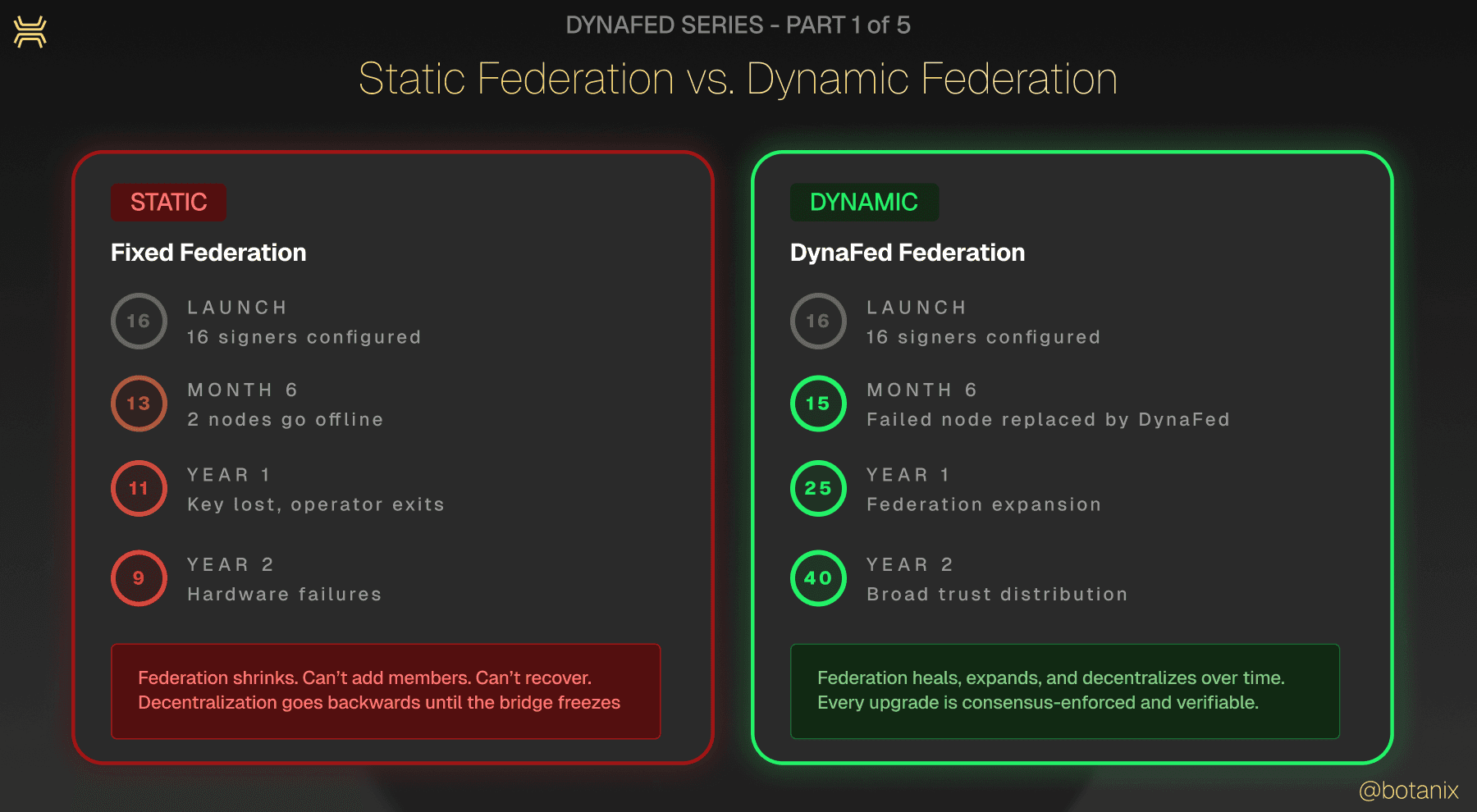
A fixed signer set doesn't just stay the same. It actively degrades. Operators shut down. Hardware fails. Keys get lost. Each quiet departure shrinks the federation and pushes it closer to the signing threshold where it can no longer function.
When that threshold is breached, user funds aren't stolen, they're frozen. The multisig can't produce valid signatures. Withdrawals stop. And there's no recovery mechanism built into the protocol.
Every lost signer makes the Bitcoin bridge more centralized, not less. A 16-signer federation that loses 3 members isn't a "12-of-16 multisig." It's effectively 12-of-12, because those empty slots are never getting filled. The trust set only shrinks. It never recovers. This is a fundamental flaw in how most Bitcoin L2 federations are designed.
Off-chain key rotation doesn't solve Bitcoin bridge decentralization
The obvious response: just rotate keys off-chain. In practice, off-chain key rotations are private ceremonies with no on-chain record, no independent verification, and no consensus enforcement. Users have to trust that the ceremony happened correctly and that the new Bitcoin multisig key is legitimate.
For anyone who values Bitcoin bridge decentralization, "trust us, we swapped the keys" should be exactly as reassuring as "trust us, we're good for it." An off-chain rotation is a custodial handoff not a verifiable federation upgrade.
How DynaFed makes Botanix's federation upgradeable
Botanix launched with a static federation and understood from day one that it was a starting configuration, not a permanent architecture. A Bitcoin custody layer that can't evolve is a brittle foundation for Bitcoin Finance.
DynaFed - Dynamic Federation turns Botanix's static multisig into a consensus-upgradeable Bitcoin bridge federation. Signers can be added, removed, or swapped without halting the chain or risking funds. Not through off-chain ceremonies, through on-chain, consensus-enforced, cryptographically verifiable transitions.

Here's what makes DynaFed different from every other approach to Bitcoin sidechain federation management:
Every migration is a hard fork - the entire network explicitly adopts, no ambiguity about which signer set is in control
New keys are generated through Distributed Key Generation (DKG) - no single party ever holds the full private key
Each participant publishes their key share on-chain - anyone can independently verify the new aggregate public key
A dual-peg grace period ensures deposits flow to both old and new addresses during the transition, zero fund risk
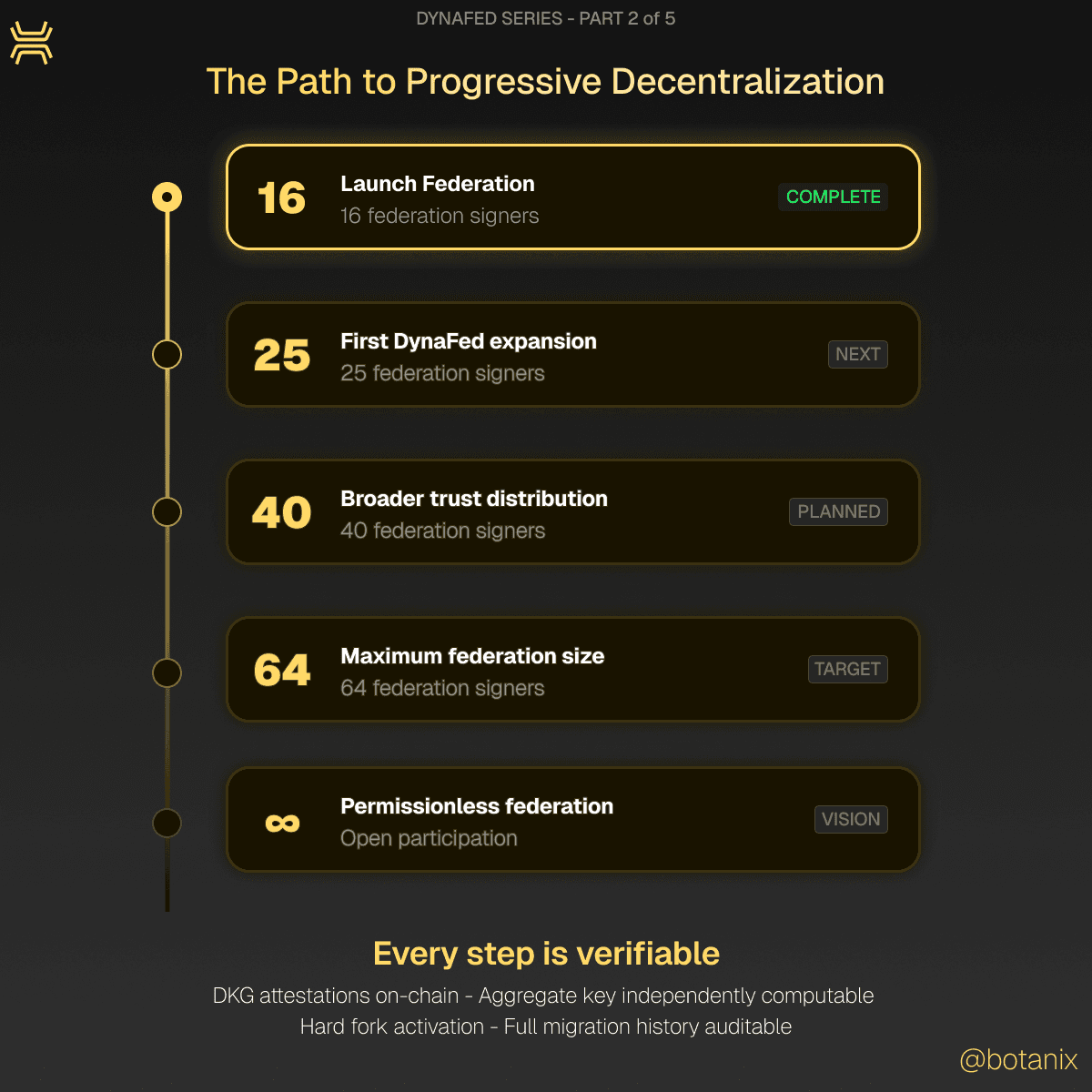
DynaFed doesn't make Botanix permissionless overnight. What it does is remove the ceiling that traps every other federated Bitcoin bridge. The federation can now expand from 16 signers to 25 to 64 with every step verifiable and consensus-enforced.
Without an upgradeable federation, Bitcoin bridge decentralization is a talking point. With DynaFed, it's a process that can actually happen.
Previous: Part 0 - DynaFed: Consensus-Driven Federation Upgrades for Botanix